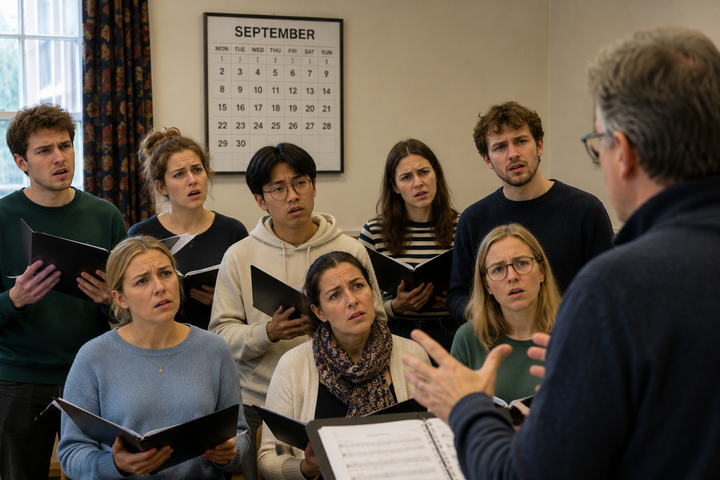
A Fresh Start: Setting the Tone for a New Choir Season The danger is that we can be so focused on where we want the choir to be in three months' time that we forget to notice where the people standing in front of us are on that particular evening.
Summer Is Part of the Season Too - we're taking a little break! Summer is not simply the gap between one year and the next. It is part of the rhythm of choir life itself.
Stop Fixing the Wrong Thing Conductors often assume that late entries are caused by uncertainty over note values, when the real culprit is confidence.
The Member Who Thinks the Conductor Is God The devotion becomes particularly entertaining whenever the conductor changes their mind.
The Member Who Is Always Saving Their Voice While the rest of the choir is attempting to engage with the exercises, they contribute what can best be described as a polite suggestion of singing. Their lips move. Some sound emerges.
The Difference Between Teaching and Conducting At its heart, conducting is a form of communication. Through gesture, posture, facial expression and movement, the conductor conveys information about tempo, dynamics, phrasing, articulation and musical character.
Yes, We Use AI. Here's Why. The articles published on Choireland are rooted in decades of real-world experience in choirs, music education, conducting, committee leadership, governance, communications, management and the wider voluntary sector.
How to Run More Efficient Choir Rehearsals Conductors want more music learned in less time. Choir members want rehearsals that feel productive, engaging and enjoyable. Committees want to see musical progress that leads to stronger performances and more successful concerts.
How to Deal with Chronic Absenteeism in a Choir If members do not know what level of attendance is expected, it becomes difficult to hold them accountable.
15 Practical Ways to Attract New Choir Members Recruiting new choir members is one of the most important responsibilities of any choir committee. Healthy membership numbers provide musical balance, financial stability and, perhaps most importantly, fresh energy and ideas.
How to Grow a Community Choir While recruitment is certainly important, it is only one part of the picture. In fact, many choirs focus so heavily on attracting new members that they overlook the factors that determine whether those members stay.
Why Your Choir Forgets Everything Over the Summer Musical learning presents additional challenges because it relies on multiple forms of memory simultaneously. Singers are not simply remembering notes.
The Choir's Unofficial Intelligence Service Every successful choir also contains an entirely unofficial role occupied by a person who appears to possess access to information that should, by any reasonable standard, be unavailable to them.