The Difference Between Teaching and Conducting
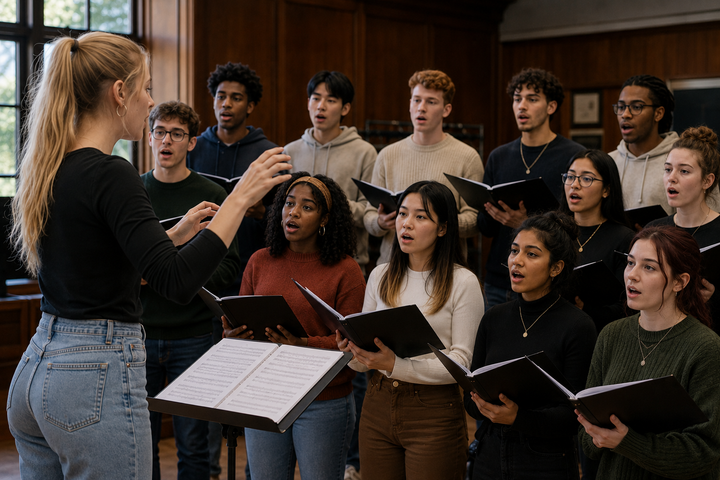
At its heart, conducting is a form of communication. Through gesture, posture, facial expression and movement, the conductor conveys information about tempo, dynamics, phrasing, articulation and musical character.

Why Great Choir Directors Need to Be Both
Many conductors spend years refining their conducting technique. They study beat patterns, score preparation, gesture, rehearsal planning, interpretation and performance practice. They attend masterclasses, observe respected colleagues and invest considerable time in developing the physical skills required to stand in front of an ensemble and communicate music effectively. These are all important aspects of the craft, and no conductor can afford to ignore them.
However, there is a reality that many choir directors eventually discover, particularly when working with community choirs. Standing in front of a choir for ninety minutes on a rehearsal night often bears surprisingly little resemblance to standing in front of a polished ensemble during a performance. While conducting may be the most visible aspect of the role, it is rarely the activity that occupies most of a conductor's time. In rehearsal, the work is often less about conducting and more about teaching.
This distinction is important because the skills required for teaching and conducting are not identical. Some conductors possess excellent technical conducting skills yet struggle to explain concepts clearly, diagnose problems or guide singers through the learning process. Equally, there are choir directors whose conducting technique may be relatively modest but who consistently achieve excellent musical results because they understand how people learn and how to help singers improve. The most successful choir leaders recognise that conducting and teaching are complementary disciplines and that effective rehearsals require both.
Conducting Is Primarily About Communication
At its heart, conducting is a form of communication. Through gesture, posture, facial expression and movement, the conductor conveys information about tempo, dynamics, phrasing, articulation and musical character. When an ensemble is secure and well prepared, the conductor's role often becomes increasingly interpretative, shaping the performance and helping singers communicate the composer's intentions with clarity and conviction.
This is the aspect of conducting that audiences see most readily. They observe the gestures, the cues and the visible relationship between conductor and choir. It is therefore understandable that many people associate conducting primarily with performance. However, while conducting is essential, it represents only part of what makes a choir successful. A beautifully shaped gesture has limited value if the singers do not yet possess the skills required to respond to it.
Teaching Is About Creating Understanding
Teaching begins where conducting leaves off. It involves helping singers develop the knowledge, awareness and technical skills necessary to make music successfully. Rather than simply indicating what should happen, the teacher helps singers understand how and why it should happen.
When a choir struggles with tuning, for example, the solution is not always found in more expressive conducting. The underlying issue may be inconsistent vowel formation, weak listening skills or a lack of understanding of harmonic relationships. Similarly, rhythmic inaccuracies are often solved not through larger gestures but through clearer explanation, better preparation or more effective rehearsal strategies. Problems relating to diction, breath management, balance and ensemble awareness are usually educational challenges rather than conducting challenges.
For this reason, the conductor's ability to teach often has a greater impact on rehearsal outcomes than their ability to conduct. Choirs improve when singers learn, and learning occurs most effectively when the conductor understands how to communicate concepts clearly and build understanding progressively.
The Best Rehearsals Are Learning Environments
Many conductors are surprised by how much of their rehearsal time is spent performing tasks that would be instantly familiar to any classroom teacher. Throughout a typical rehearsal they explain concepts, demonstrate examples, ask questions, provide feedback, diagnose difficulties and help singers break complex challenges into manageable steps. In doing so, they create an environment in which learning can take place.
This is one reason why the most productive rehearsals often look very different from performances. Rather than spending the entire evening conducting complete pieces from beginning to end, effective conductors frequently pause to address specific issues, isolate difficult passages and explore underlying musical concepts. The objective is not simply to get through the repertoire but to develop the skills that will allow the choir to perform that repertoire successfully.
When singers leave rehearsal with greater understanding, increased confidence and improved musicianship, meaningful progress has occurred. The performance benefits are simply the visible result of that learning process.
Teaching Requires Patience and Long-Term Thinking
Another important distinction between teaching and conducting lies in the timescale of results. Conducting often seeks an immediate response. A gesture is given and the choir reacts instantly. Teaching, by contrast, is usually a slower process. Learning takes time, habits require reinforcement and technical development rarely occurs overnight.
This can occasionally be frustrating for conductors who are eager to achieve rapid improvement. However, many of the most important aspects of choral singing develop gradually. Intonation, listening skills, vocal production, ensemble awareness and stylistic understanding often require weeks, months or even years of consistent reinforcement.
The conductors who achieve lasting results tend to understand this reality. Rather than becoming frustrated when progress is incremental, they recognise that effective teaching involves planting seeds that may not become visible until much later in the rehearsal process.
The Ability to Diagnose Problems Is a Teaching Skill
One of the most valuable abilities a choir director can develop is the capacity to identify the true cause of a problem. Many conductors can hear that something is wrong. The more difficult task is understanding why it is wrong.
A chord that sounds out of tune may actually be a vowel issue. A rhythmic problem may stem from uncertainty about breathing rather than uncertainty about rhythm itself. A balance issue may arise because singers lack confidence rather than because they are incapable of producing sufficient sound. Similarly, a phrase that lacks shape may reflect poor breath management rather than a lack of musicality.
The conductor who can identify these root causes is far more likely to solve problems efficiently. This diagnostic process is fundamentally a teaching activity, requiring observation, analysis and the ability to select an appropriate solution. In many rehearsals, it is this skill rather than conducting technique that determines how much progress is achieved.
Community Choirs Depend on Teaching
The importance of teaching becomes even more apparent within community choirs. Unlike professional ensembles, community choirs often contain singers with widely varying levels of musical experience. Some may read music fluently, while others learn almost entirely by ear. Some arrive with years of choral experience, while others are encountering formal music-making for the first time.
In such an environment, teaching is not an optional extra. It is an essential component of successful choir leadership. Conductors must help singers develop the skills required to participate confidently and effectively, while creating a supportive environment in which learning feels achievable rather than intimidating. When teaching is done well, choirs are often capable of performing repertoire that initially appeared beyond their reach.
The Most Effective Choir Directors Combine Both Roles
The finest choir directors rarely think of themselves solely as conductors or solely as teachers. Instead, they recognise that both roles are inseparable. Their conducting provides artistic direction and musical shape, while their teaching equips singers with the tools required to realise that vision.
During performances, conducting may become the dominant aspect of the role. During rehearsals, teaching often takes centre stage. Throughout both contexts, however, the conductor remains a leader whose primary responsibility is helping people make music together.
This is perhaps the most important distinction of all. Successful choir directors are not simply individuals who know how to beat time or shape a phrase. They are educators, communicators and facilitators who understand how to guide singers towards higher levels of musical achievement. Their success is measured not by the elegance of their gestures but by the growth of the people standing in front of them.
Ultimately, the goal of a choir director is not merely to conduct music. It is to help singers develop the skills, confidence and understanding required to bring that music to life. Viewed in that light, conducting and teaching are not separate activities at all. They are two sides of the same responsibility, and the choirs that thrive are usually led by people who understand the importance of both.