Why Your Choir Forgets Everything Over the Summer
Musical learning presents additional challenges because it relies on multiple forms of memory simultaneously. Singers are not simply remembering notes.
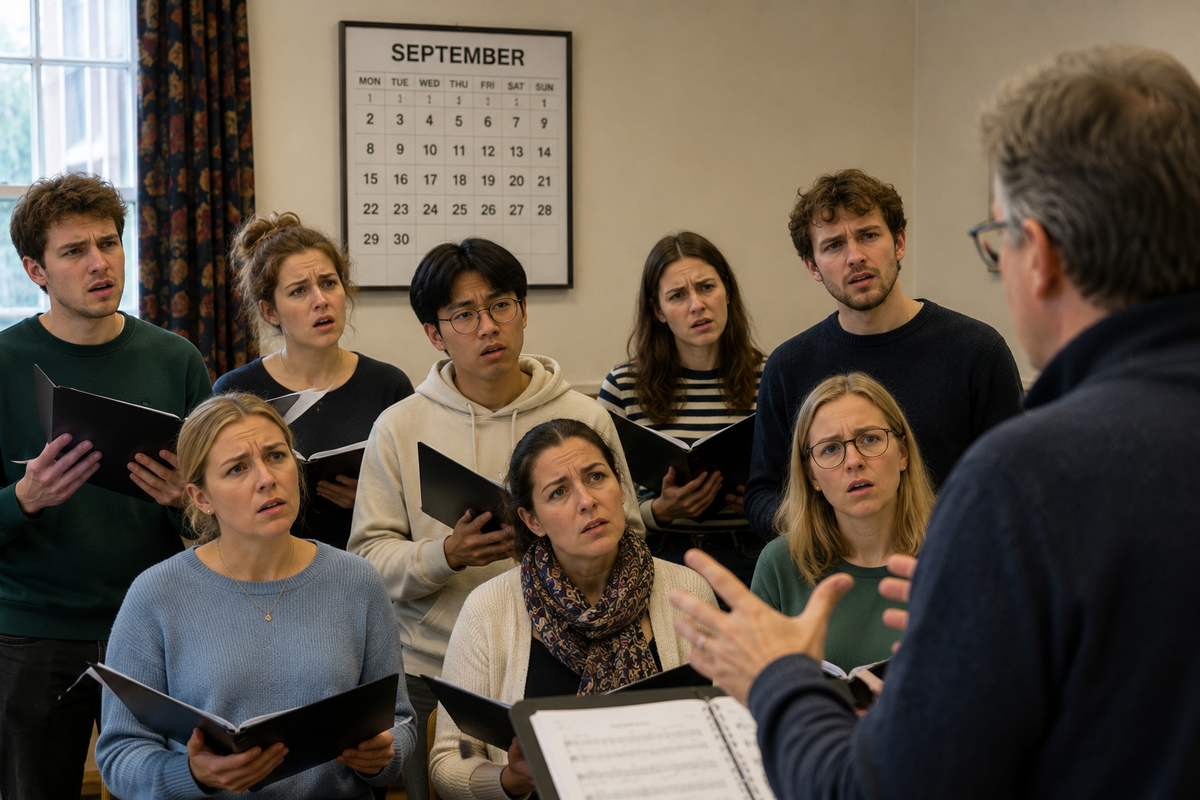
Every September, conductors around the world experience the same moment of disbelief. A piece that sounded polished and performance-ready in May suddenly appears unfamiliar. Entries are hesitant, rhythms are uncertain and singers stare at the score as though encountering it for the first time. The immediate temptation is to conclude that the choir has forgotten everything.
In reality, something rather more interesting is happening.
Human memory was never designed to preserve information indefinitely without reinforcement. Decades of cognitive research have demonstrated that learned material fades when it is not revisited regularly. This phenomenon, often referred to as the "forgetting curve," was first identified by German psychologist Hermann Ebbinghaus in the nineteenth century and has been repeatedly confirmed by subsequent research. Put simply, information that is not actively recalled becomes progressively harder to access over time.
Choirs are not immune to this process.
When singers rehearse weekly over a sustained period, they build strong musical memories. Notes, rhythms, words and performance practices become increasingly familiar through repetition. However, much of this learning remains dependent on regular reinforcement. Remove rehearsals for several weeks and those memory pathways begin to weaken. The information has not necessarily disappeared, but access to it becomes slower and less reliable.
This distinction is important because forgetting and retrieval are not the same thing.
Many singers become concerned when they return after a summer break and struggle to recall passages they previously knew well. Yet memory researchers have long understood that the act of retrieving information is itself a powerful form of learning. The apparent struggle to remember often helps strengthen memory more effectively than passive review. What feels like forgetting may actually be the process of rebuilding and reinforcing knowledge that still exists beneath the surface.
Musical learning presents additional challenges because it relies on multiple forms of memory simultaneously. Singers are not simply remembering notes. They are recalling text, pronunciation, breathing plans, dynamic markings, cut-offs, stylistic choices and the countless small decisions that contribute to a successful performance. Some elements fade more quickly than others. Words may remain remarkably secure while rhythms become uncertain. Entries may be forgotten even though pitches remain familiar.
The social nature of choir singing also plays a role.
During the season, singers benefit from a powerful network of cues. They hear neighbouring voices, watch the conductor and respond to familiar rehearsal routines. These external supports become part of the learning process. After a lengthy break, the choir must re-establish those connections before confidence fully returns.
Fortunately, the picture is not entirely negative.
Research consistently shows that relearning is significantly faster than initial learning. A choir may feel rusty during the first rehearsal or two, but material that took months to prepare originally can often be restored surprisingly quickly. The brain retains traces of previous learning even when immediate recall appears weak. Once rehearsals resume, these pathways are reactivated far more efficiently than when the music was first introduced.
This is one reason experienced conductors rarely panic during the opening weeks of a new season. What appears to be a dramatic decline in standards is often a temporary adjustment period. The choir is not starting from the beginning. It is reconnecting with knowledge that already exists.
There are practical lessons here for conductors as well. The final rehearsals before a summer break should not simply focus on preparing for the next performance. They should also aim to strengthen long-term retention. Pieces that are revisited periodically throughout the season tend to survive breaks more successfully than those rehearsed intensively for a short period and then abandoned. Similarly, encouraging singers to engage with recordings or scores during the summer can help maintain familiarity without requiring formal rehearsal.
Perhaps the most reassuring conclusion is that forgetting is not evidence of failure.
It is evidence that the choir is human.
Memory is not a filing cabinet in which information is stored permanently and retrieved perfectly on demand. It is a dynamic process that strengthens through use and weakens through neglect. Every choir experiences this cycle. The difference between successful ensembles and struggling ones is not that one group forgets and the other does not.
It is that successful choirs understand forgetting is part of learning, and they trust the process of rebuilding when September arrives.