Why Choirs Go Flat
Flat singing is one of the most common frustrations in amateur choral singing. It affects school choirs, parish choirs, chamber ensembles, workplace choirs and competition groups alike.
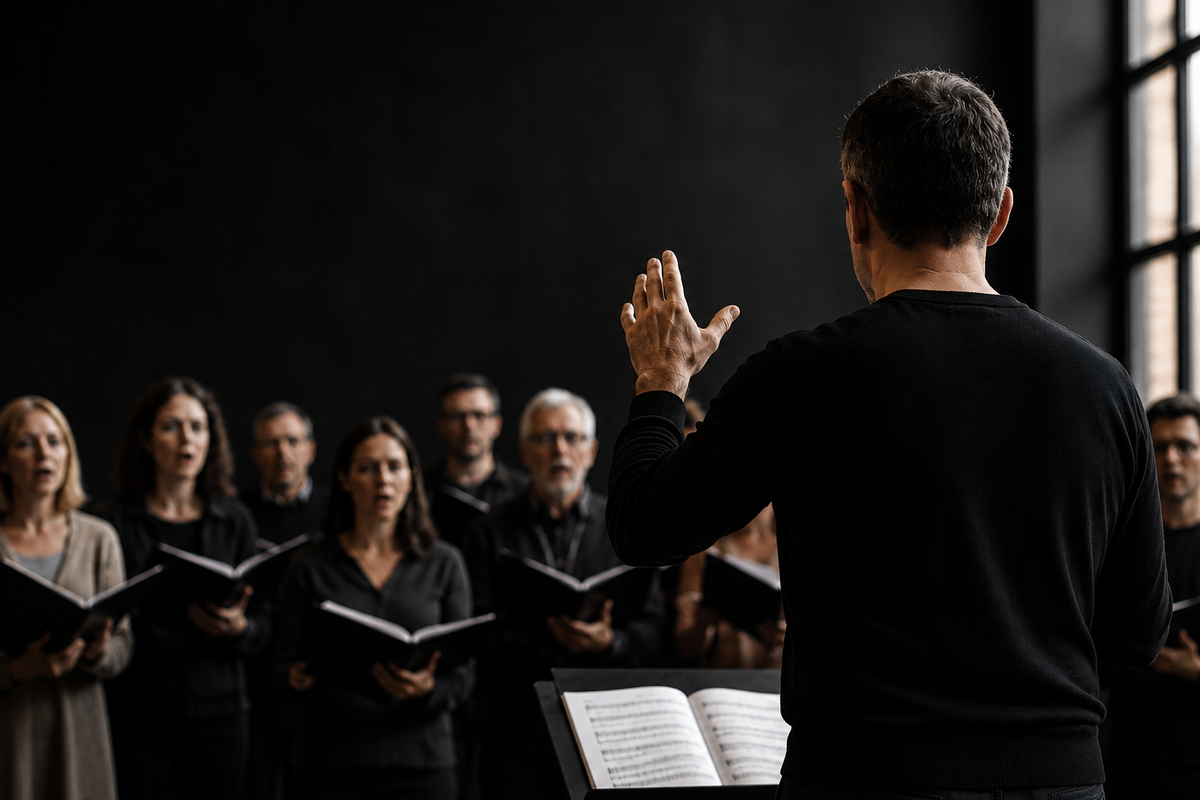
There are few more demoralising moments in a rehearsal room than reaching the final page of a piece and discovering the choir has somehow descended by almost a semitone.
Everyone feels it.
The accompanist starts pressing the keys slightly harder, hoping denial might somehow sharpen the pitch. The basses look mildly offended. Sopranos begin reaching upward with increasing desperation. The conductor smiles bravely while internally calculating how much rehearsal time is about to disappear into emergency repair work.
Flat singing is one of the most common frustrations in amateur choral singing. It affects school choirs, parish choirs, chamber ensembles, workplace choirs and competition groups alike. Even very good choirs are not immune.
The important thing to understand is this:
Choirs rarely go flat because singers are lazy or untalented.
They usually go flat because of energy.
Pitch Is Energy
Conductors often treat flat singing as a purely technical issue. It can be, but more often it is physical and psychological.
A choir with low physical energy will almost always sit under the pitch.
Tired posture, passive breathing, weak consonants and cautious singing all pull the sound downward. The tone loses spin. Vowels widen. Breath pressure drops. Suddenly the final chorus sounds like it belongs to another arrangement entirely.
The uncomfortable truth is that many choirs rehearse in a permanent state of partial fatigue.
People arrive from work.
They have spent the day sitting down.
They are carrying stress.
Some have barely spoken all day. Others have spent the entire day speaking.
Then we ask them to produce energetic, resonant, aligned sound at 8:15 on a Tuesday evening under fluorescent lighting beside a stack of tea cups and raffle tickets.
Perspective matters.
The Real Causes of Flat Singing
Most persistent flatness comes from a combination of small issues rather than one catastrophic flaw.
1. Weak Breath Energy
If singers are not moving air properly, pitch immediately becomes unstable.
Choirs often confuse “soft singing” with “under-supported singing”. They are not the same thing.
Quiet singing still needs energy.
In fact, pianissimo singing often requires more technical support than loud singing.
2. Lazy Consonants
Consonants create rhythmic and physical energy inside ensemble singing.
Weak diction causes sluggish ensemble response and collapsing pitch.
A choir with crisp consonants almost always sings higher in the pitch centre than a choir with soft, vague diction.
Good diction energises tuning.
3. Overly Dark Vowels
This is especially common in choirs trying very hard to sound “classical”.
The tone becomes heavy and covered. Vowels spread horizontally. The sound loses lift.
Many Irish choirs unintentionally darken vowels in pursuit of blend, warmth or “cathedral sound”.
The result can be beautiful for about forty seconds.
Then gravity takes over.
4. Physical Posture
Poor posture affects breathing, alertness and resonance simultaneously.
Many conductors underestimate how dramatically posture influences tuning.
Flat choirs often look physically tired before they sound physically tired.
5. Rehearsing Too Loudly
This surprises many conductors.
Constant full-volume singing creates vocal fatigue quickly, especially in amateur ensembles.
Fatigued voices lose pitch stability.
A good rehearsal has dynamic contrast and periods of vocal recovery.
Conductors Often Make It Worse
One of the most common mistakes is stopping repeatedly to tell singers:
“You’re flat.”
This rarely fixes the underlying problem.
In fact, it often creates anxiety, caution and tighter singing — all of which can worsen tuning.
Instead of focusing only on pitch, focus on:
- energy,
- breath,
- posture,
- text,
- and forward momentum.
Fix the mechanism and the pitch usually follows.
Practical Rehearsal Fixes
Here are several reliable ways to improve pitch immediately in rehearsal.
Reset Physical Energy
Never try to repair tuning while the room looks half asleep.
Make singers stand properly.
Reset posture.
Use movement if necessary.
Physical engagement changes pitch instantly.
Brighten the Text
Ask for:
- clearer consonants,
- more forward vowels,
- slightly brighter tone.
Not harsher.
Not shoutier.
Just more energised.
Rehearse More Quietly
A choir that rehearses everything at full volume becomes vocally exhausted long before the concert arrives.
Controlled singing creates healthier pitch habits.
Avoid Over-Conducting
Conductors sometimes drag pitch downward through heavy, downward physical gestures.
Large weighted beats can create heavy sound.
Lift matters.
The Bigger Truth
Pitch problems are rarely just pitch problems.
They are usually symptoms:
- low energy,
- weak engagement,
- physical fatigue,
- unclear text,
- hesitant singing,
- or rehearsal habits that slowly drain the choir.
The best choirs do not necessarily sing with perfect tuning every second.
They sing with consistent collective energy.
And energy keeps pitch alive.
That is the real work of rehearsal.