Stop Talking So Much
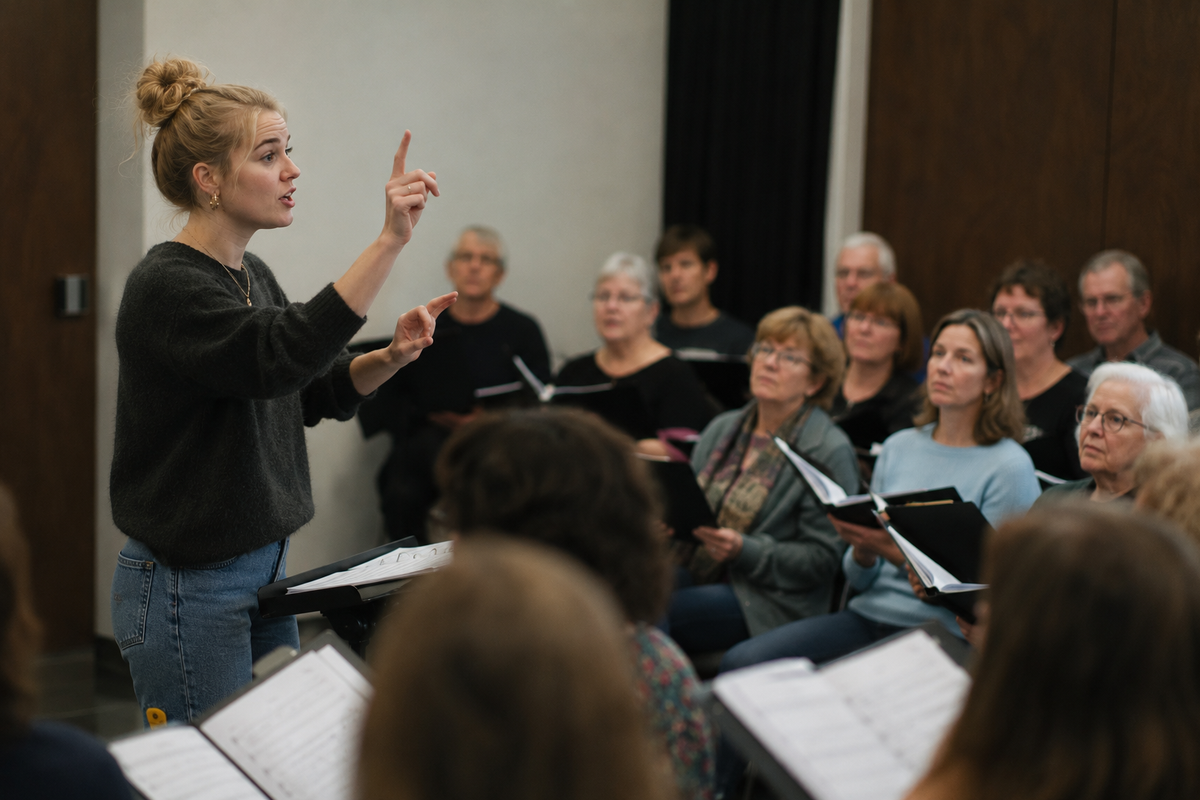
One of the most common rehearsal mistakes conductors make has nothing to do with technique, repertoire or musicianship. It is talking for too long.
Most conductors begin rehearsing because they love music.
Unfortunately, many eventually begin rehearsing as though the choir has arrived to attend a lecture.
This happens gradually.
At first, explanations are useful. A conductor clarifies phrasing, fixes rhythm, discusses vowels and shapes interpretation carefully. The room feels engaged. Progress happens quickly.
Then, somewhere along the way, the balance shifts.
Five-second corrections become three-minute speeches. Conductors begin explaining the emotional significance of individual crotchets. Entire historical backgrounds emerge between page turns. The accompanist slowly develops the thousand-yard stare of somebody trapped inside an educational podcast they never consented to downloading.
Meanwhile, the choir stops singing.
And the less a choir sings during rehearsal, the worse the rehearsal usually becomes.
“Most musical problems are solved faster by singing again than by discussing them endlessly.”
There is a simple truth conductors sometimes forget:
singers learn physically.
Choirs are not orchestras. They are not classrooms. They are certainly not TED Talks with occasional tonic sol-fá exercises inserted for variety.
Singers need repetition, momentum and physical engagement. Long verbal interruptions break all three.
Energy leaks from the room astonishingly quickly once people stop actively making music. Posture collapses first. Then concentration drifts. Water bottles appear. Somebody quietly checks a smartwatch beneath their folder with the subtlety of international espionage.
The atmosphere changes.
This is especially true after a full workday, when many amateur singers arrive already mentally exhausted. Conductors often mistake fading rehearsal energy for laziness or lack of commitment when, in reality, the room has simply stopped moving.
Talking creates stillness.
Too much stillness drains choirs.
Good conductors understand pacing instinctively. They know rehearsals have rhythm in exactly the same way performances do. Tension builds. Release matters. Momentum matters. Silence matters too, but only when used intentionally.
The best rehearsals often feel surprisingly fast.
Not rushed.
Just alive.
Corrections become concise. Instructions become clearer. Conductors begin trusting singers to discover certain things through repetition rather than explanation. Musical problems get fixed inside the flow of singing instead of outside it.
This does not mean rehearsals should become mindless sing-throughs. Some moments absolutely require detailed work. Difficult tuning passages, language coaching and stylistic shaping all demand careful attention.
But clarity is not the same thing as quantity.
Some of the most effective conductors say remarkably little.
A single sentence delivered clearly at the right moment will always outperform four minutes of wandering explanation. In fact, singers tend to remember concise imagery far more effectively than technical dissertations.
“Lift the line.”
“Spin the vowel.”
“Don’t sit on the phrase.”
“Breathe like the sentence matters.”
The room understands immediately.
There is also a deeper psychological issue underneath excessive talking: conductors sometimes speak too much because silence feels uncomfortable. Constant explanation creates the reassuring illusion of control.
But choirs do not become confident because conductors explain everything perfectly.
They become confident because they sing successfully.
That is the real goal.
Rehearsals should leave singers feeling musically energised rather than intellectually over-briefed. People rarely drive home discussing the conductor’s excellent verbal analysis of bar 47.
They remember whether the rehearsal felt alive.
And usually, the rehearsals that feel most alive are the ones where the choir spends less time listening to the conductor speak and more time singing.