Stop Starting at the Beginning
Good conductors understand that rehearsal time should feel slightly uncomfortable. Difficult transitions need to be isolated. Awkward page turns need repetition.
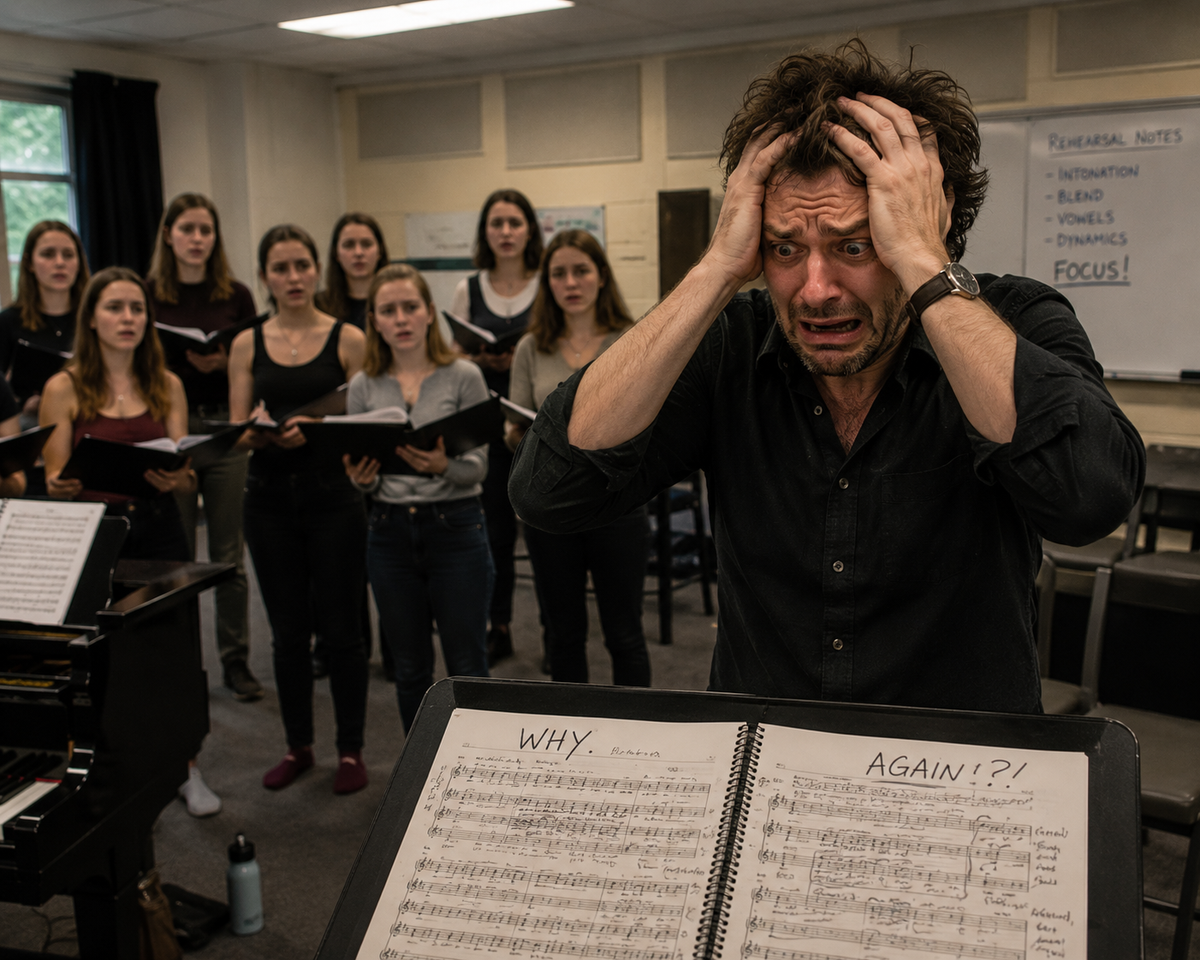
One of the fastest ways to drain energy from a rehearsal is constantly returning to bar one every time something goes wrong.
Conductors do this constantly.
A passage falls apart halfway through the piece. The tenors miss an entry. Somebody loses the beat entirely during a modulation. The accompanist briefly experiences emotional abandonment.
And immediately, the conductor says:
“Right. Back to the top.”
The choir obeys.
Again.
And again.
And eventually, everybody begins rehearsing the opening page with the confidence and polish of the Vienna Philharmonic while the final third of the piece remains structurally unstable enough to concern engineers.
This happens because starting from the beginning feels psychologically tidy. It creates the illusion of continuity and control. The conductor feels momentum returning. The choir feels familiar ground underneath them again.
Unfortunately, it is usually terrible rehearsal technique.
Most rehearsal problems are local problems, not global ones. Returning repeatedly to the opening bars simply teaches choirs two dangerous habits:
firstly, that concentration matters less later in the piece, and secondly, that difficult passages can always be escaped by resetting the musical clock.
Choirs become strangely dependent on musical reincarnation.
“Some ensembles rehearse the first page fifty times and the ending twice.”
Good conductors understand that rehearsal time should feel slightly uncomfortable. Difficult transitions need to be isolated. Awkward page turns need repetition. Dangerous entries must survive scrutiny under pressure rather than being protected inside complete sing-throughs.
This is especially true for amateur choirs, where rehearsal memory often attaches itself geographically to the score. Many singers unconsciously learn music as a sequence of physical events rather than a fully internalised structure.
That is why choirs sometimes collapse entirely when asked:
“Can we start at letter G?”
Suddenly people begin turning pages with the atmosphere of survivors searching maps after a natural disaster.
The basses accidentally arrive at the coda.
One soprano starts humming bar one quietly for orientation.
A tenor asks whether letter G is before or after the modulation “with the accidentals.”
The conductor briefly regrets every life choice that led here.
Yet rehearsing isolated sections properly transforms ensembles surprisingly quickly. Choirs become less dependent on momentum and more capable of genuine recovery. Internal counting improves. Confidence strengthens. Musical understanding deepens.
Most importantly, singers stop associating success exclusively with familiar openings.
There is also a deeper psychological truth underneath all of this: performances almost never collapse at the beginning.
The opening is usually fine.
Disaster waits later.
It waits after the long rests.
After the page turn.
After the exposed modulation.
After the section everybody secretly hoped the adjudicator would somehow not notice.
That is where rehearsals should live more often.
Not permanently, of course. Complete sing-throughs matter enormously for pacing, stamina and emotional continuity. But rehearsals become dramatically more efficient once conductors stop treating the opening page as a form of emotional support.
Choirs do not improve because they repeatedly survive the safest part of the piece.
They improve because they finally learn how to survive the dangerous parts.