The Singer Who Treats Every Rehearsal Like Opening Night
This person attacks the opening vocalise with the commitment of somebody auditioning for international representation.
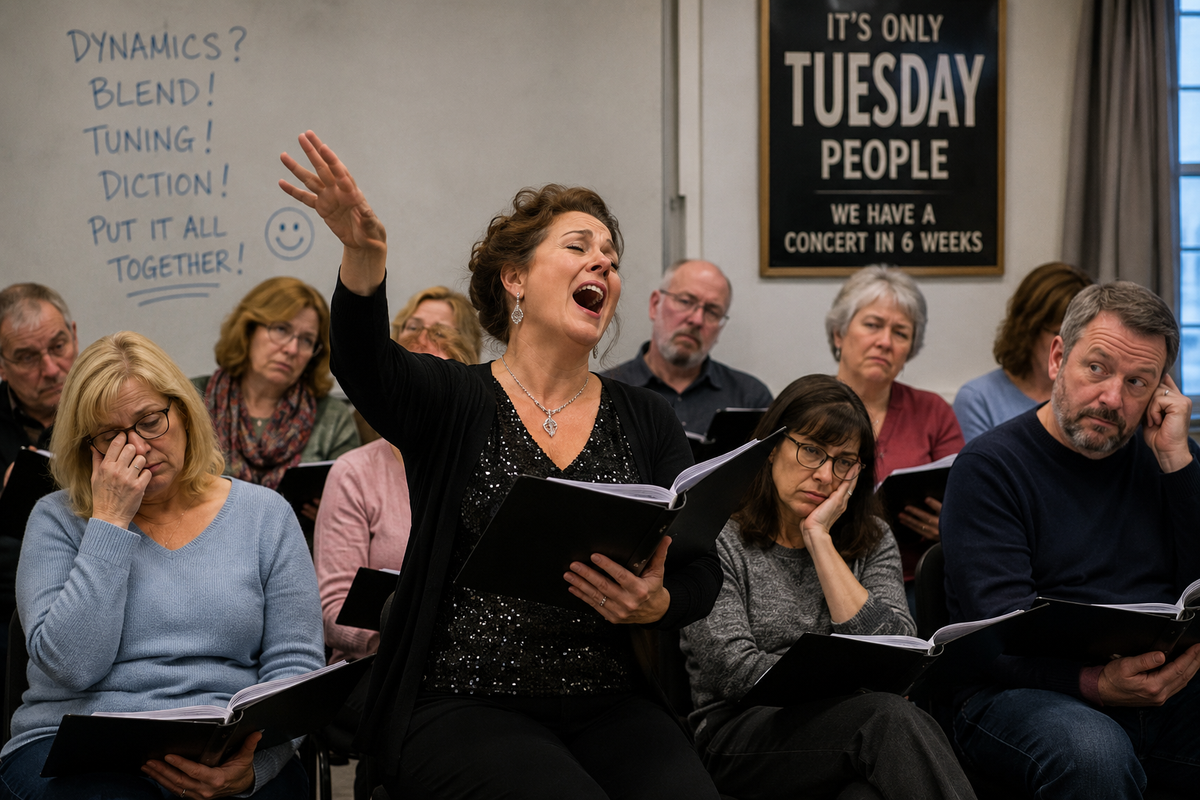
Every choir has one. A singer who arrives at an ordinary Tuesday rehearsal with the emotional energy of somebody about to make their West End debut.
This is not necessarily a bad quality.
At first.
Enthusiasm is admirable. Commitment is welcome. A choir full of disengaged half-hearted mutterers would be far worse than a room containing one person who appears genuinely delighted to be alive in the key of E flat.
But there are limits.
The opening signs are usually visual.
While everyone else arrives looking as though they have survived work, traffic, family negotiations and some form of low-level existential fatigue, this individual enters fully assembled. Hair immaculate. Outfit thoughtfully curated. Expression alert. Hydration apparently optimised.
They look less like an amateur chorister and more like somebody attending a press launch for themselves.
Then rehearsal begins.
The warm-up starts with a modest humming exercise.
Most singers participate sensibly, preserving energy, locating their voices, and attempting not to alarm nearby altos.
Not this person.
This person attacks the opening vocalise with the commitment of somebody auditioning for international representation.
Every note is emotionally available.
Every vowel is fully realised.
Every consonant has legal force.
“Some singers warm up. Others begin their personal campaign for artistic immortality.”
This energy escalates rapidly.
A simple phrase-marking exercise becomes interpretative theatre. A neutral sight-reading passage receives dynamic shaping no conductor requested. Consonants arrive sharpened enough to cause minor injury.
And then comes the inevitable solo-adjacent behaviour.
No actual solo has been assigned.
This is irrelevant.
The singer has detected a phrase requiring slight prominence and has accepted the responsibility voluntarily.
The surrounding section becomes increasingly aware that they are now providing backing vocals for an entirely unofficial personal showcase.
To be fair, these singers are often genuinely excellent musicians. That is partly what makes the phenomenon so funny. This is rarely incompetence. It is simply dramatic overinvestment in circumstances that absolutely do not require it.
A note-learning rehearsal in a parish hall should not resemble the emotional climax of a televised concert event.
Yet here we are.
The accompanist notices first.
Accompanists always notice first.
There is often a specific look exchanged between pianist and conductor which translates roughly as:
Is this happening?
The answer is always yes.
Particularly remarkable is the stamina. Most singers naturally modulate their effort depending on context. They understand the difference between rehearsal singing and performance singing.
The opening-night singer rejects this distinction completely.
For them, every fermata matters.
Every cadence deserves consequence.
Every entrance may define a legacy.
By the interval, ordinary mortals are conserving energy for the second half.
This person is somehow still gaining momentum.
And yet, choirs would miss them terribly if they disappeared.
Because beneath the comic excess lies something strangely valuable: pure, unapologetic enthusiasm.
Yes, they over-sing.
Yes, they occasionally treat scale exercises like Mahler.
Yes, their relationship with proportional response may need careful review.
But they care.
Deeply.
And in amateur music-making, that is not the worst thing to endure.
Even if nobody needed full emotional devastation during diction work.