The Singer Who Mouths During Difficult Bits
Instead, the difficult-bit mouther remains theatrically involved while quietly outsourcing all actual musical responsibility to stronger section members.
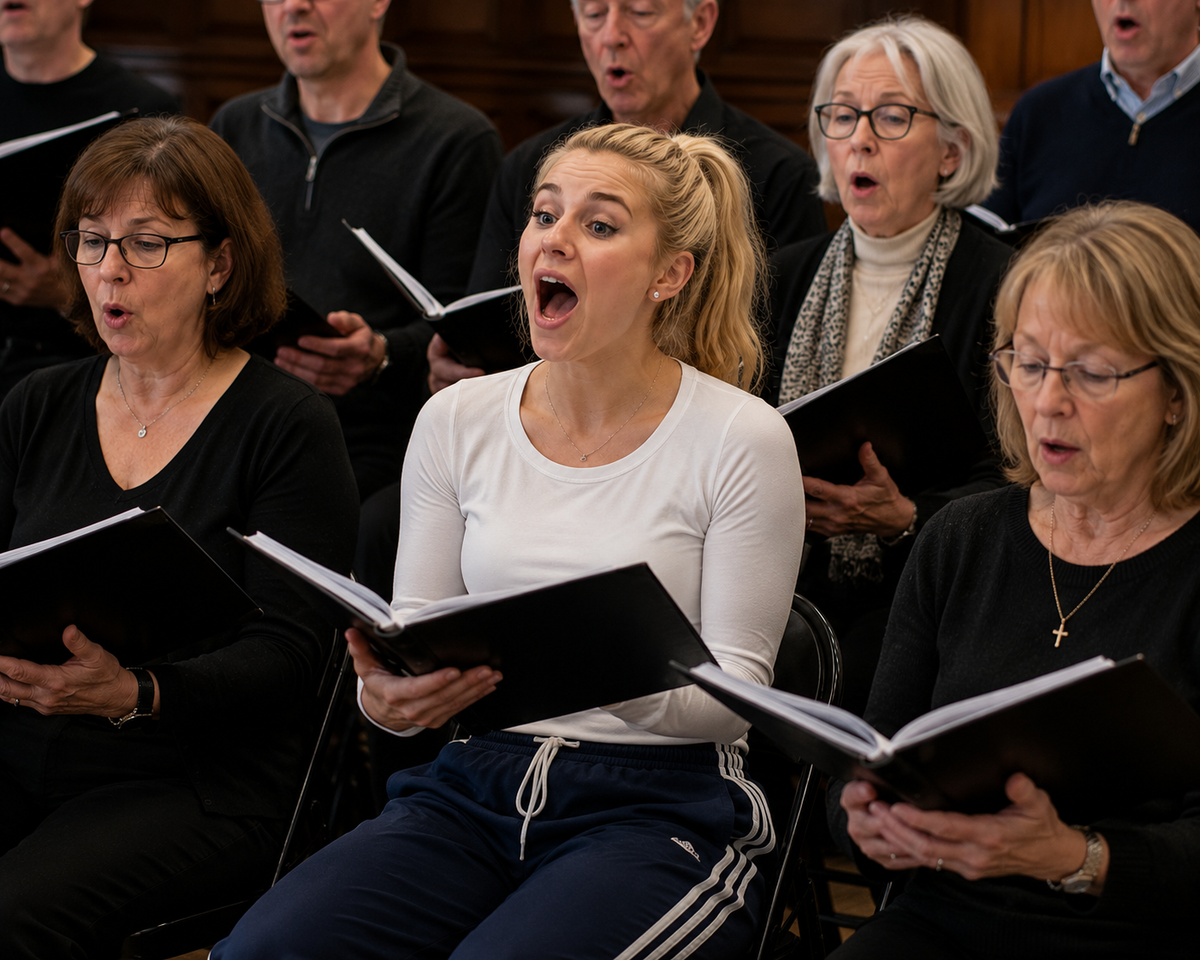
Every choir has one. A singer whose commitment to ensemble participation remains inspiring right up until genuine musical jeopardy appears.
At first, they seem entirely dependable.
Warm-ups? Fully engaged.
Homophonic hymn textures? Rock solid.
Christmas repertoire they have sung since the collapse of the Celtic Tiger? Utterly unstoppable.
Then the music becomes even slightly inconvenient.
A divided alto entry appears in compound time after three bars of counting.
A fugue begins.
Somebody says the words “German diction”.
And suddenly something extraordinary happens.
They continue singing.
Visually.
No actual sound emerges, of course.
But the face remains deeply committed.
The expression says:
“I am absolutely with you.”
The audio evidence suggests otherwise.
This is a very specific choir survival strategy. Not outright disengagement. That would be too honest. Instead, the difficult-bit mouther remains theatrically involved while quietly outsourcing all actual musical responsibility to stronger section members.
From a distance, it is almost convincing.
The conductor sees movement.
Text.
Breathing.
Intent.
Everything appears operational.
Then the section sound arrives suspiciously one voice lighter than mathematics suggests.
“The most dangerous choir members are not the ones who get things wrong. It is the ones who become acoustically hypothetical.”
These singers are often remarkably sophisticated operators.
They know precisely when to re-enter.
A familiar cadence appears?
Back in.
Long held note in English?
Fully restored.
Unison passage with piano doubling?
Suddenly giving it everything.
Their instincts for self-preservation are extraordinary.
Particularly impressive is the way they maintain eye contact with the conductor during silent participation, creating the unsettling illusion of complete artistic commitment.
Occasionally, the mouthing becomes overconfident.
This produces the dreaded delayed fake entry, where the singer guesses incorrectly that the danger has passed and rejoins several beats before the section has actually located civilisation.
The effect is rarely subtle.
What makes this phenomenon especially funny is that almost every experienced choir member has done some version of it.
Not regularly, obviously.
Not as a lifestyle.
But certainly:
- during awkward sight-reading,
- exposed divisi,
- contemporary notation,
- and whatever exactly is happening rhythmically in modern Baltic repertoire.
The difficult-bit mouther is not always lazy.
Sometimes they are simply overwhelmed.
Sometimes they lost the line twenty seconds ago and are surviving on facial acting alone.
Sometimes the conductor made the deeply optimistic decision to begin from letter M without warning.
In those moments, mouthing becomes less deception and more emergency humanitarian response.
Still, there are professionals within this category.
Veterans.
People who can mime entire movements with astonishing emotional sincerity while contributing less actual sound than a moderately thoughtful houseplant.
And somehow, choirs tolerate them.
Because the uncomfortable truth is this:
when rehearsals become sufficiently chaotic, almost everybody becomes the difficult-bit mouther eventually.
Some are simply better at hiding it.