The Singer Who Marks Absolutely Nothing
They simply nod with enormous sincerity and continue staring at the page as though the information will transfer telepathically into long-term memory.
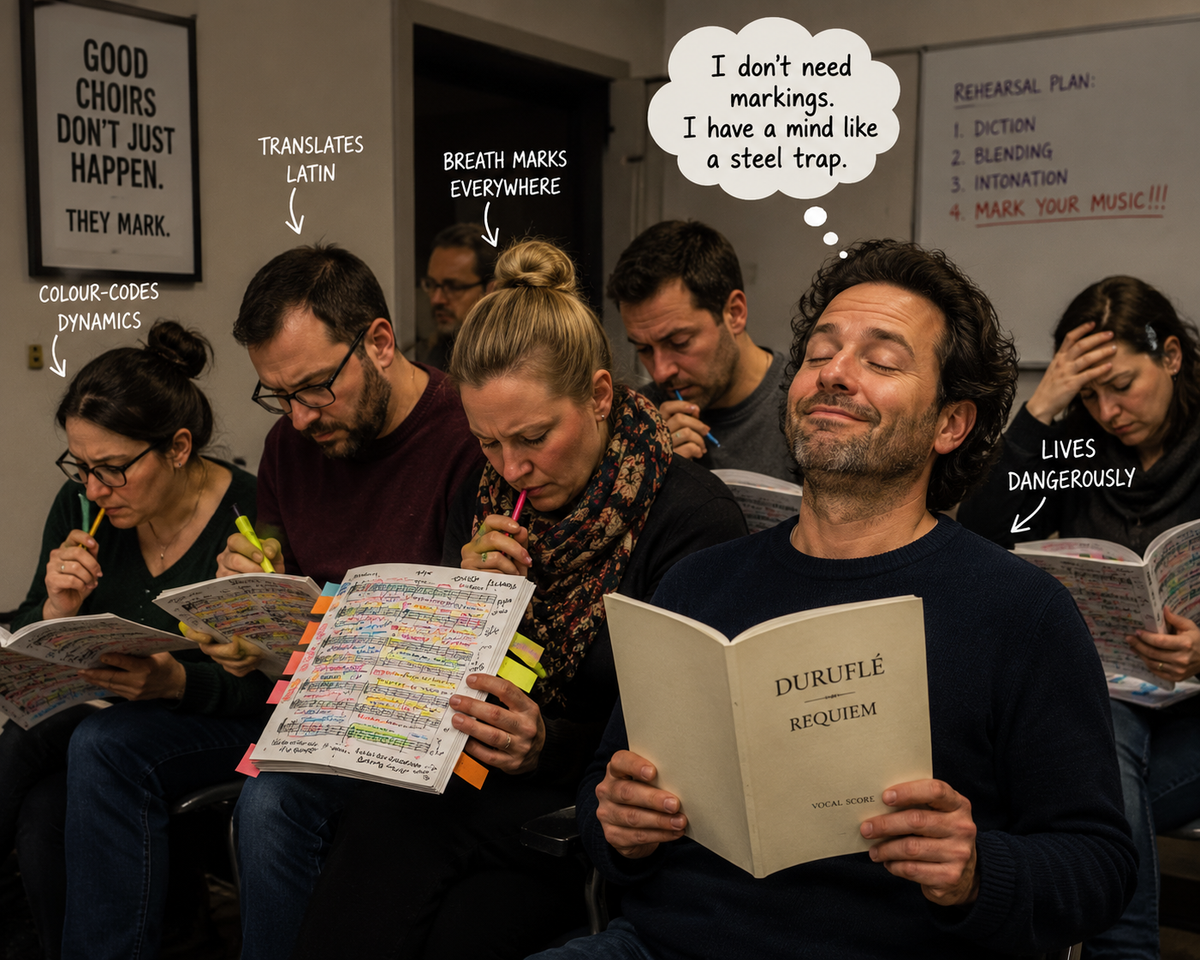
Every choir has one. A singer who approaches printed music with the confidence of somebody decoding ancient prophecy entirely from instinct.
You know the person immediately.
Everybody else arrives carrying:
- pencils,
- colour-coded markings,
- translations,
- reminders,
- emergency breath marks,
- and enough annotations to reconstruct the fall of the Roman Empire.
Meanwhile, this individual opens a completely untouched score purchased sometime during the Obama administration.
Not one marking.
Not a single dynamic.
No breaths.
No cues.
No circles.
No translations.
Nothing.
The pages look spiritually brand new.
This becomes increasingly disturbing as rehearsals progress.
By week four, the conductor has stopped repeatedly to insist:
“Please mark that.”
Everybody scribbles obediently.
Except one person.
They simply nod with enormous sincerity and continue staring at the page as though the information will transfer telepathically into long-term memory.
It never does.
Naturally, this same singer becomes deeply dependent on collective movement during performances. Their entire survival strategy revolves around detecting tiny behavioural signals from neighbouring section members.
If three altos inhale suddenly, they inhale suddenly.
If the basses turn a page aggressively, they turn a page aggressively.
Occasionally this produces catastrophic chain reactions where half the section enters early because one confident idiot misread a repeat marking with the authority of a military commander.
The conductor ages visibly in real time.
“At some point every choir member believes they will remember the instruction later. Nobody remembers the instruction later.”
The untouched-score singer also possesses extraordinary optimism about rehearsal memory generally.
“Oh yes,” they say calmly.
“I remember this bit.”
They do not remember this bit.
In fact, they do not remember any bit. What they actually remember is a vague emotional impression that something musical happened in this region of the page approximately three Thursdays ago.
Page turns become especially dangerous. Since there are no markings, tabs or structural clues, performances often involve moments of pure archaeological uncertainty while they search for the correct entry point somewhere inside seventeen identical systems of semi-quavers.
The truly remarkable thing is that these singers are often extremely experienced choir members.
They have survived decades this way.
Entire concert tours.
Competition finals.
Major works.
Nothing written down.
Somehow, against all known organisational logic, they continue functioning through a combination of instinct, panic and aggressive eye contact with stronger musicians nearby.
And perhaps that is the great secret truth about amateur choirs generally.
Underneath all the rehearsal technique, sectional discipline and artistic ambition, a surprising percentage of ensemble singing is still held together by people quietly hoping somebody else knows where they are.