Your Choir Is More Tired Than You Think
Choirs are not collections of full-time musicians arriving physically and mentally prepared for artistic excellence on demand.
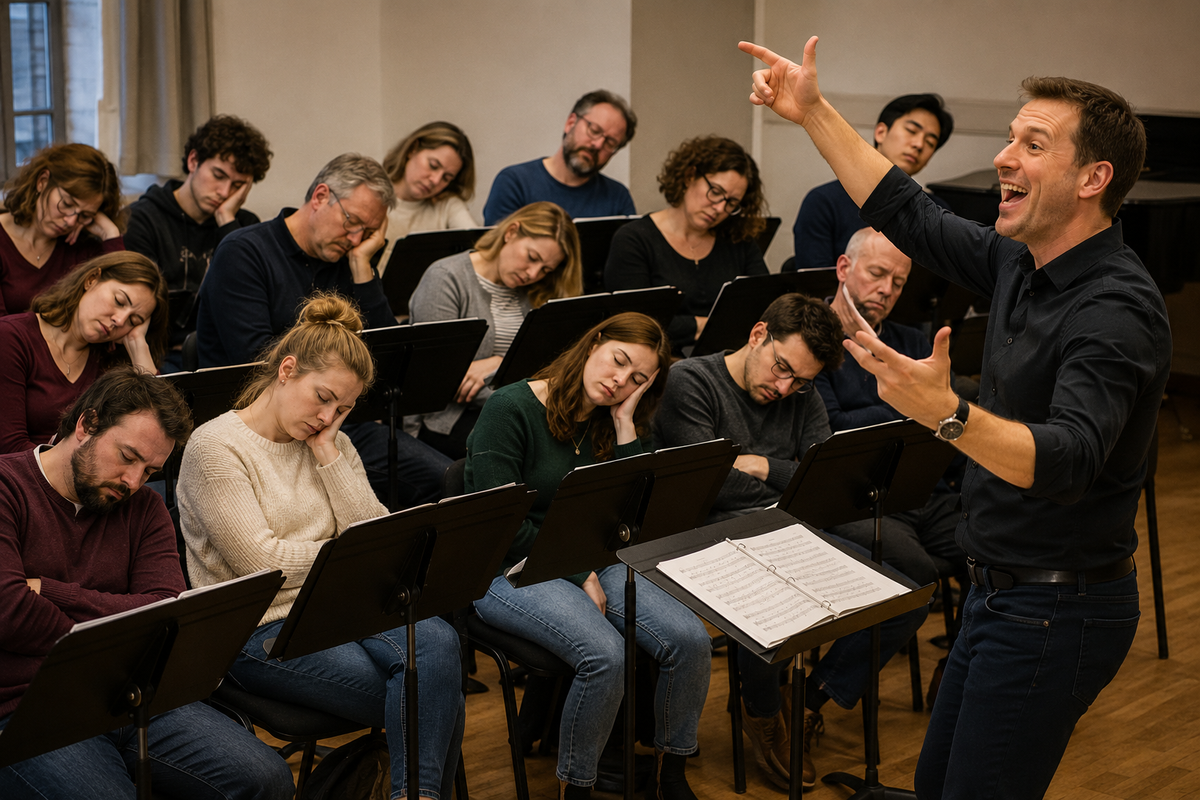
Conductors sometimes rehearse as though their singers have spent the previous twelve hours in silent reflection, light stretching and nutritional optimisation. This is almost never the case.
By the time many amateur singers arrive at rehearsal, they have already completed what feels like a full additional life.
They have survived:
emails,
meetings,
school pickups,
traffic,
unreasonable clients,
missed lunches,
domestic negotiations,
and at least one entirely unnecessary administrative crisis.
Some have eaten dinner in the car.
Some have not eaten at all.
One tenor has almost certainly sprinted in directly from somewhere stressful while pretending this is completely normal.
And then rehearsal begins.
Immediately.
With:
“Right, let’s take that from bar 63.”
No warm arrival.
No mental reset.
No transition from ordinary life into music.
Just instant Brahms.
This is where conductors sometimes fundamentally misunderstand the reality of amateur choral life.
Choirs are not collections of full-time musicians arriving physically and mentally prepared for artistic excellence on demand. They are teachers, nurses, accountants, solicitors, parents, retired engineers, students and people who have spent the last hour trying to remember whether they actually locked the back door.
Fatigue is not the exception.
It is the default setting.
“A tired choir is not necessarily an uncommitted choir.”
This matters because tired singers behave differently.
Listening slows.
Pitch drifts.
Instructions need repeating.
Humour becomes essential.
Concentration comes in waves rather than clean uninterrupted stretches.
Conductors sometimes interpret these signs unfairly.
The room feels flat, so standards rise sharply.
Frustration creeps in.
Instructions become shorter.
Patience evaporates.
The choir gets even more tired.
An elegant little downward spiral.
This does not mean rehearsals should become indulgent therapy sessions involving herbal tea and collective emotional processing.
Standards still matter.
But intelligent conductors understand pacing.
They know that energy must often be created rather than assumed.
Sometimes that means beginning with something familiar rather than immediate note surgery.
Sometimes it means changing rehearsal order.
Sometimes it means simply noticing that the room is mentally somewhere else for the first fifteen minutes and adjusting accordingly.
The best conductors read fatigue almost as carefully as they read scores.
They know when precision work will fail.
When humour will help.
When a quick win matters.
When the choir needs movement instead of explanation.
And yes, occasionally when everyone simply needs to survive the evening with dignity intact.
There is also a seasonal truth here.
November choirs are different from May choirs.
Competition-week choirs are different from ordinary-week choirs.
December choirs are essentially functioning through mince pies, stress and religious obligation.
Good conductors know this instinctively.
Because the goal is not to lower standards for tired singers.
The goal is to rehearse tired singers intelligently.
The amateur choir that sounds miraculous on stage is rarely the one with the least fatigue.
It is usually the one whose conductor understood exactly what kind of room they were actually standing in.