The Person Who Starts Packing Before the Final Chord Ends
From that moment onward, the final cadence becomes psychologically contaminated. Nobody is thinking about blend anymore. Half the altos are now wondering who did it.
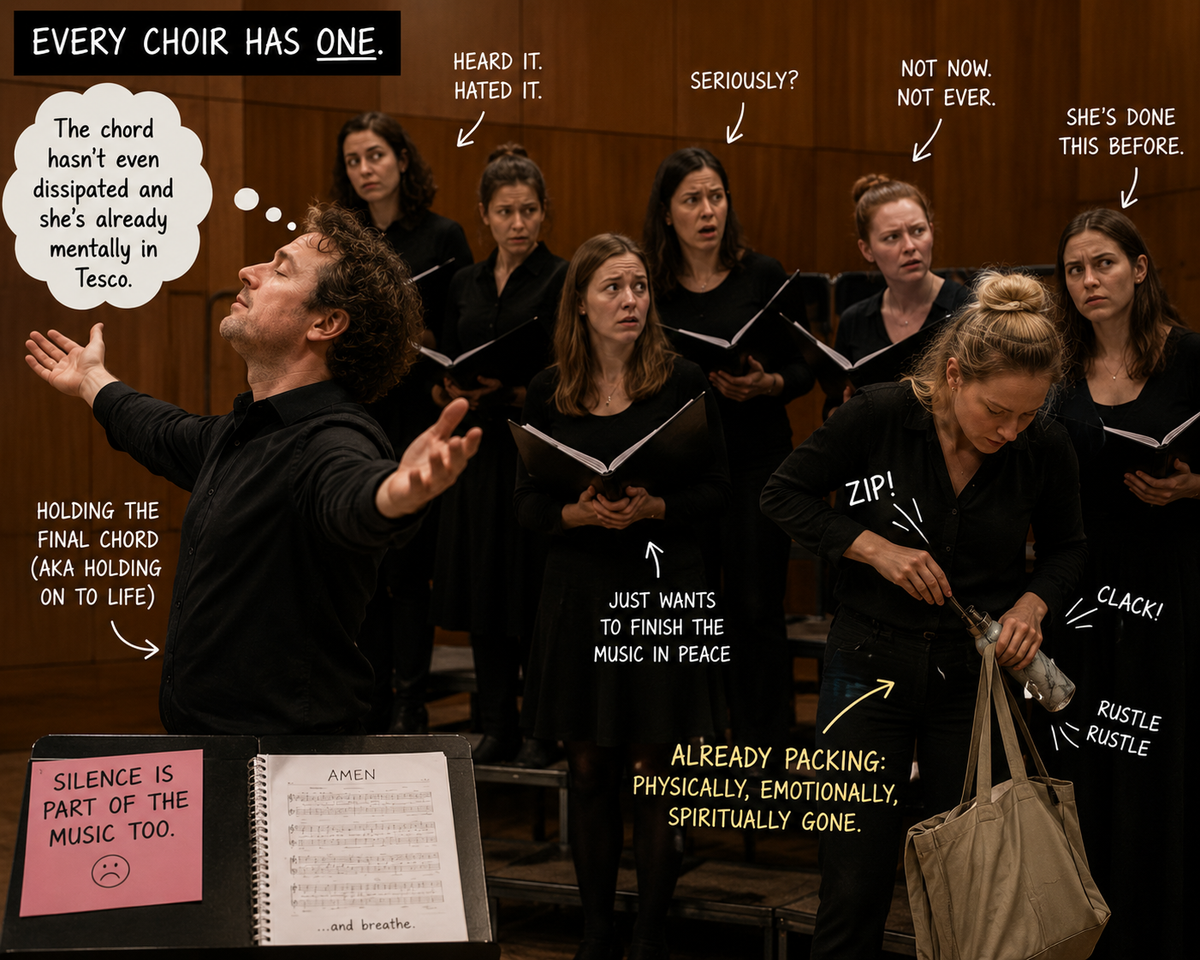
Every choir has one. A singer who treats the final chord not as the end of the piece, but as an early warning system for immediate administrative departure.
The phenomenon usually begins subtly.
The choir is deep inside the final page of a sacred work. The atmosphere is reflective. The conductor is shaping the closing phrases with visible emotional investment. Sopranos are attempting spiritual transcendence somewhere above the stave.
Then suddenly:
click.
A folder closes.
Not loudly.
Not aggressively.
Just enough to send a small but devastating shockwave through the ensemble’s collective nervous system.
The conductor hears it immediately.
Conductors always hear it immediately.
From that moment onward, the final cadence becomes psychologically contaminated. Nobody is thinking about blend anymore. Half the altos are now wondering who did it. A tenor near the back begins prematurely locating his car keys with the discretion of a man opening crisps in a theatre.
The piece limps toward its conclusion under increasingly unstable conditions.
And then comes the true masterwork of rehearsal-room selfishness:
the pre-applause zip.
“Nothing destroys the atmosphere of a beautiful ending faster than somebody aggressively locating a raincoat.”
The early packer operates according to a completely different understanding of musical timing. In their mind, once the final note has technically occurred, all artistic obligations immediately expire.
Silence?
Reflection?
Resonance?
Absolutely not.
There are buses to catch.
These singers often display extraordinary confidence in their own logistical priorities. While the conductor is still physically holding the atmosphere together with raised hands and fragile emotional dignity, the early packer is already halfway inside a tote bag searching for a reusable coffee cup.
Occasionally they begin conversations.
This is genuinely one of the most psychologically destabilising things a choir member can witness.
The conductor remains frozen in post-performance stillness while, somewhere in the second alto row, somebody whispers:
“Are we still on for the Chinese after this?”
Civilisation collapses surprisingly quickly after that.
The remarkable thing is that early packers are rarely malicious people. In fact, they are often warm, generous choir members who simply possess no awareness whatsoever of post-cadential etiquette.
To them, the piece is over.
The sound has stopped.
The transaction is complete.
What they fail to understand is that for conductors, the silence after the final chord is part of the music itself. Sometimes it is the most important part. Audiences need a moment to sit inside what they have just heard before reality barges back in holding car keys and supermarket bags.
That silence matters.
Which is precisely why the premature folder snap feels so spiritually violent.
Still, every choir eventually develops coping mechanisms. Conductors begin holding final chords longer than necessary simply to establish dominance. Singers exchange warning glances before exposed endings. Entire ensembles become briefly united in silent judgment whenever somebody reaches for a scarf during a pianissimo cutoff.
And yet the early packer survives.
They always survive.
Somewhere, in choirs across Ireland tonight, a conductor is still holding the final chord of a beautifully shaped motet while one determined individual quietly attempts to put on a jacket before the Amen has emotionally landed.
The rest of the choir watches in horror.
As tradition demands.