The Conductors Who Cannot Bear Silence
The strongest rehearsals often contain surprisingly little talking. Not because the conductor lacks insight, but because the conductor understands that timing matters.
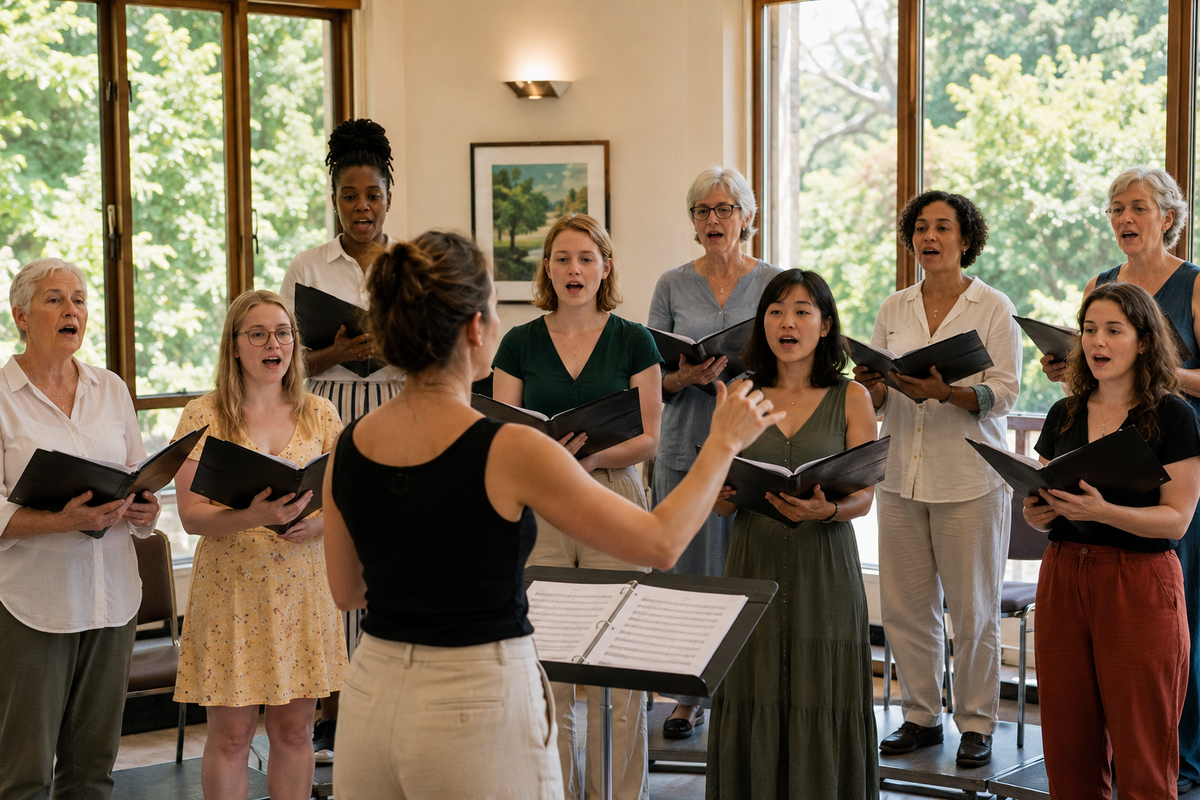
Some conductors fear silence in rehearsal with an intensity usually reserved for electrical failure or public scandal.
The moment singing stops, something in the room becomes intolerable to them. A cutoff barely lands before commentary begins. Instructions arrive instantly. Corrections emerge mid-breath. Somebody in the alto section is still locating a pencil when the conductor has already launched into three overlapping observations about vowels, tempo and consonants.
The room never quite settles.
There is always another sentence arriving.
This habit is extraordinarily common, particularly among intelligent and enthusiastic conductors who care deeply about efficiency. The instinct makes sense on paper. Silence can feel wasteful. Empty space can feel awkward. Conductors often believe constant verbal engagement keeps energy alive and rehearsal momentum moving forward.
In reality, the opposite frequently happens.
Choirs need processing time far more than conductors realise.
A musical instruction is not absorbed the moment it is spoken. Singers need a second or two to connect the correction to the score, understand where it applies, hear it internally and prepare to execute it physically. When instructions arrive in relentless succession, the choir gradually stops fully absorbing any of them.
The rehearsal becomes linguistically busy but musically blurred.
“Some conductors fill silence because they fear losing control. The best conductors often trust silence to do part of the work for them.”
There is also a subtler problem underneath all this talking.
Constant commentary can unintentionally weaken ensemble listening.
If every cutoff is immediately followed by the conductor’s voice, singers never fully develop the habit of internally evaluating what they just heard. The room becomes dependent on external analysis rather than collective awareness. Instead of listening critically to tuning, balance or ensemble clarity, singers wait passively for the podium to explain what happened.
Over time, this changes the culture of rehearsal itself.
The choir listens upward more than outward.
The strongest rehearsals often contain surprisingly little talking. Not because the conductor lacks insight, but because the conductor understands that timing matters. A concise, precise instruction delivered at the right moment is infinitely more effective than a continuous stream of verbal accompaniment.
Silence can also create authority.
Many inexperienced conductors believe authority comes from constant intervention. In reality, conductors who speak less are often listened to more carefully. When every sentence carries purpose, singers pay attention differently. Rehearsal language becomes sharper because it is not competing with unnecessary commentary.
There is a psychological calmness to this style of leadership as well.
Choirs reflect conductor energy with alarming accuracy. If the podium feels frantic, the room feels frantic. If every silence is rushed to extinction, singers begin rehearsing with low-level tension, as though mistakes must be corrected instantly before disaster fully unfolds.
Good conductors understand that not every imperfect moment requires immediate verbal rescue.
Sometimes the cutoff should simply hang in the room for a second.
Sometimes singers need time to hear the chord decay naturally.
Sometimes the most useful thing a conductor can do after a weak passage is absolutely nothing for three seconds.
Those three seconds often contain more musical thinking than another paragraph of explanation ever could.
Silence is not rehearsal failure.
Used properly, it is part of the rehearsal itself.