The Complete Guide to Choir Attendance Policies
Mention attendance requirements at a committee meeting and opinions often emerge quickly. Some believe attendance should be entirely voluntary, arguing that choirs are leisure activities and members should participate as their schedules allow.
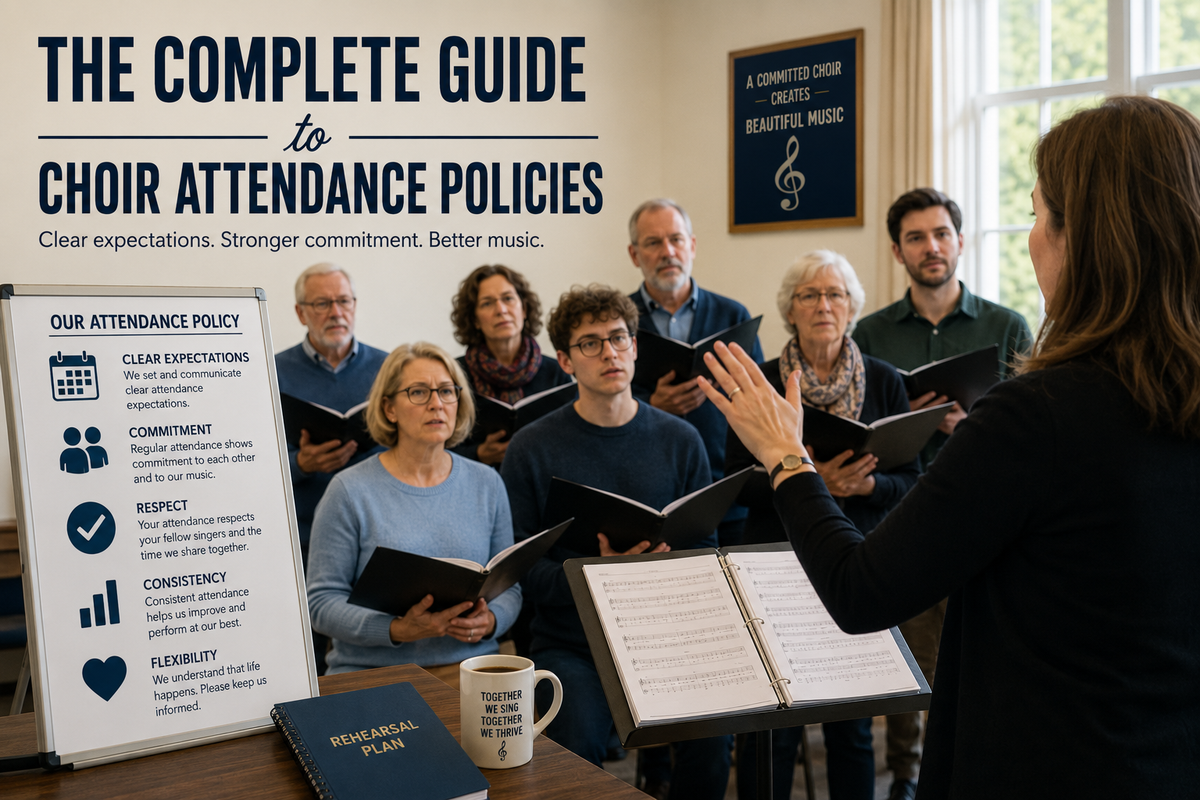
Why Every Choir Needs One, and How to Make It Work
Few topics generate more debate within choirs than attendance.
Mention attendance requirements at a committee meeting and opinions often emerge quickly. Some believe attendance should be entirely voluntary, arguing that choirs are leisure activities and members should participate as their schedules allow. Others take the opposite view, insisting that high standards can only be maintained through strict attendance expectations.
The reality lies somewhere between these positions.
An attendance policy is not about punishing members. Nor is it about creating bureaucracy for its own sake. At its best, an attendance policy provides clarity. It helps singers understand what is expected of them, protects the musical standards of the ensemble and ensures that decisions are made fairly and consistently.
Without a policy, attendance issues often become personal. One singer may be challenged while another is not. Decisions may appear arbitrary. Frustration can develop among members who attend regularly while others participate only occasionally. A clear policy removes much of this uncertainty by establishing expectations in advance.
The first question every choir should ask is what problem they are trying to solve.
A chamber choir preparing demanding competition repertoire faces different challenges from a large community choir presenting a Christmas concert. Attendance expectations should reflect the nature of the organisation. Policies that are too strict may discourage participation, while policies that are too relaxed can undermine musical progress.
For most choirs, the goal should be reliability rather than perfection.
Life happens. Work commitments arise. Family responsibilities intervene. Illness is unavoidable. A good attendance policy recognises these realities while still protecting the interests of the ensemble. Members should not be expected to attend every rehearsal, but neither should attendance become entirely optional.
Many choirs choose to establish a minimum attendance percentage. A figure somewhere between 70% and 80% is common and generally strikes a reasonable balance between flexibility and commitment. The precise percentage is less important than ensuring it reflects the choir's ambitions and is applied consistently.
However, attendance percentages alone rarely tell the whole story.
The final rehearsals before a performance often carry greater significance than those earlier in the preparation process. A singer who has attended most rehearsals but misses the final run-through may create more difficulty than someone whose absences occurred several months earlier. For this reason, many successful choirs include specific requirements regarding dress rehearsals, workshop days or final rehearsals.
Communication is equally important.
Attendance policies should never be hidden away in constitutions or committee documents. Members should understand the policy from the moment they join the choir. Expectations should be discussed openly and reinforced regularly. People are generally willing to meet standards when those standards are clear and reasonable.
Choirs should also think carefully about how attendance is recorded.
Informal systems often work well in smaller groups, but larger organisations usually benefit from more structured approaches. Whether attendance is recorded through a register, digital platform or section leaders, accuracy matters. Once attendance data begins influencing performance eligibility or membership reviews, records must be reliable.
The question of exemptions requires particular sensitivity.
Life events do not affect all members equally. Illness, bereavement, caring responsibilities and professional obligations may occasionally impact attendance. A good policy allows for discretion while avoiding the appearance of favouritism. The aim should be consistency without rigidity. Committees and Musical Directors should retain the ability to consider exceptional circumstances when necessary.
One of the most common mistakes choirs make is introducing a policy and then failing to enforce it.
This creates more problems than having no policy at all.
When members see attendance requirements being ignored, confidence in the system quickly disappears. Choirs do not need to become overly disciplinary, but they do need to follow through on the standards they establish. Consistency is what gives a policy credibility.
Equally important is recognising that attendance should never be viewed as the sole measure of contribution. Some singers attend every rehearsal and contribute positively to the culture of the choir. Others may meet attendance requirements while bringing a negative attitude or poor preparation. Attendance is an important indicator of commitment, but it is not the only one.
Perhaps the most successful attendance policies are those that are reviewed periodically.
Choirs evolve. Membership changes. Repertoire becomes more or less demanding. What worked five years ago may not work today. Reviewing the policy every few seasons allows organisations to adapt to changing circumstances while ensuring that expectations remain appropriate.
Ultimately, attendance policies are not about control.
They are about fairness.
They provide clarity for members, support for Musical Directors and confidence for committees. Most importantly, they help ensure that the singers standing on stage have been given the best possible opportunity to prepare together.
That benefits everyone involved.
Five Principles of a Good Attendance Policy
A good attendance policy should be clear, proportionate, consistently applied, flexible enough to recognise exceptional circumstances and aligned with the musical ambitions of the choir.
Five Common Mistakes
The most common mistakes are setting unrealistic expectations, failing to communicate the policy properly, recording attendance inconsistently, making exceptions without transparency and failing to enforce the standards that have been established.
An attendance policy will never eliminate every challenge. Human beings are far too complicated for that. What it can do is provide a framework within which decisions can be made fairly, openly and in the best interests of both the singers and the choir as a whole.