The Choir That Thinks It’s Democratic
Community choirs should absolutely be welcoming, collaborative and member-focused. That does not mean they should be run like a permanent constitutional convention.
Community choirs should absolutely be welcoming, collaborative and member-focused. That does not mean they should be run like a permanent constitutional convention.
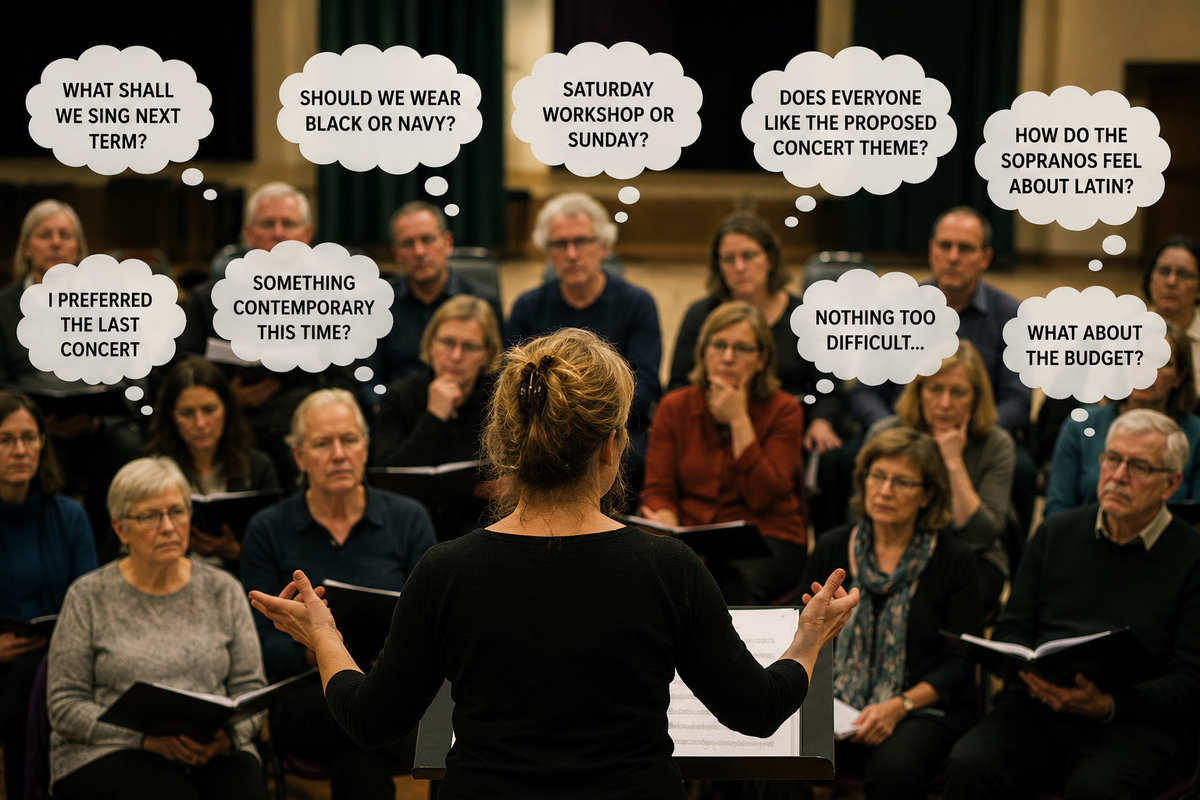
There is a particular kind of choir culture where every decision becomes a matter for consultation.
What shall we sing next term?
Should we wear black or navy?
Would people prefer a Saturday workshop or a Sunday one?
Should rehearsal start fifteen minutes earlier?
Does everyone like the proposed concert theme?
How does the soprano section feel about Latin?
On the surface, this can look wonderfully inclusive.
Members feel heard. Opinions are gathered. Leadership appears responsive. There is a warm sense that everyone has a voice.
And then absolutely nothing gets decided.
Because choirs are not parliaments.
They are artistic organisations.
That distinction matters.
A successful choir depends on leadership making clear, thoughtful decisions in service of a musical vision. Consultation has its place, certainly. It would be absurd to suggest members should be treated like obedient conscripts with no agency whatsoever. But some choirs drift into a culture where leaders become so afraid of disappointing anyone that decision-making slows to a crawl.
The result is a peculiar kind of organisational paralysis.
Repertoire becomes especially vulnerable. Rather than building a coherent artistic programme, some choirs begin choosing music the way extended families choose takeaway food: by attempting to satisfy every competing preference simultaneously.
One singer wants contemporary.
Another wants sacred.
Three basses want something “properly choral.”
Somebody dislikes foreign languages.
Someone else thinks everything should be lighter this year.
One long-serving alto mentions how much everyone enjoyed The Armed Man in 2014 and suddenly the conversation loses six weeks.
“The moment artistic programming becomes a popularity contest, mediocrity is usually waiting nearby.”
This is not an argument for dictatorship.
Poor leadership hides behind that excuse often enough.
The best choir leaders listen intelligently. They recognise legitimate practical concerns. They understand member morale matters. They create space for feedback.
But listening is not the same as outsourcing leadership.
Not every preference deserves equal strategic weight.
If a conductor has genuine artistic expertise, it is perfectly reasonable for that expertise to shape repertoire choices. If a committee understands operational realities, it is entirely appropriate for them to make practical decisions without launching a choir-wide referendum about biscuit procurement or rehearsal start times.
Democracy is a wonderful political system.
It is a questionable rehearsal model.
The deeper issue is often emotional rather than structural. Leaders sometimes seek universal agreement because disagreement feels uncomfortable. Asking everyone’s opinion can become a way of diffusing responsibility. If the decision proves unpopular, at least nobody made it alone.
That may feel safer.
It is rarely effective.
Strong choirs are not built by permanently managing preference.
They are built by trust.
Trust that the conductor knows what the choir needs musically.
Trust that leadership is making sensible operational decisions.
Trust that not every individual disappointment represents organisational failure.
Because let us be honest: in any functioning choir, somebody will always dislike something.
The repertoire.
The seating plan.
The rehearsal schedule.
The concert venue.
The interval biscuits.
That is simply human life in organised groups.
A choir where everybody gets exactly what they want is not a choir.
It is a fantasy administrative experiment.
Healthy choirs are collaborative communities.
But they still need leaders willing to lead.