Inside the Committee: The Chairperson
A good Chairperson knows how to listen carefully while still moving discussions towards a conclusion.

Leading Without Conducting
In many choirs, the Chairperson is often viewed as the person who runs the meetings, keeps discussions moving and occasionally reminds members that the AGM is approaching. While these responsibilities are certainly part of the role, they barely scratch the surface of what effective chairmanship actually involves.
The truth is that the Chairperson has more influence over the health of a choir than almost any other committee position.
Not because they make the most decisions.
Not because they hold the greatest authority.
But because they shape the environment in which decisions are made.
The most successful Chairpersons understand that leadership and control are not the same thing. Their role is not to dominate discussions, dictate outcomes or personally solve every problem that emerges. Instead, they create the conditions in which good governance, effective planning and positive relationships can flourish.
This requires a particular set of skills.
A good Chairperson knows how to listen carefully while still moving discussions towards a conclusion. They understand that endless debate is rarely productive, but neither is rushing decisions without proper consideration. Committee members need to feel heard, but they also need to feel that progress is being made. Striking that balance is one of the defining characteristics of effective leadership.
Perhaps nowhere is this more important than in the relationship between the Chairperson and the Musical Director.
Many of the difficulties that arise within choirs can be traced back to confusion about where artistic leadership ends and organisational leadership begins. The Musical Director is responsible for the artistic direction of the choir. The committee is responsible for ensuring the organisation is financially, legally and operationally sustainable. The Chairperson plays a crucial role in maintaining respect for both sides of that relationship.
Strong Chairpersons support their Musical Directors without becoming involved in artistic decision-making. They recognise that repertoire selection, rehearsal methodology and musical standards fall within the conductor's area of expertise. Equally, they ensure that artistic ambitions remain grounded in practical realities. The healthiest choirs are those in which both committee and Musical Director understand their respective responsibilities and communicate openly.
Another important aspect of the role involves culture.
Every choir develops a culture whether it intends to or not. Some become collaborative, welcoming and forward-looking. Others become resistant to change, dominated by personalities or trapped in cycles of unnecessary conflict. The Chairperson cannot control every interaction within the organisation, but they exert enormous influence over the tone of discussions and the behaviour that is accepted.
Committee members tend to take their cues from the person leading the meeting. A Chairperson who remains calm under pressure encourages others to do the same. A Chairperson who treats differing opinions with respect creates space for healthy debate. A Chairperson who focuses on solutions rather than blame helps the organisation move forward when challenges arise.
Importantly, good Chairpersons do not feel compelled to have all the answers.
One of the most common misconceptions about leadership is that it requires certainty at all times. In reality, effective leaders are often distinguished by the quality of their questions rather than the certainty of their opinions. They know how to draw expertise from others, encourage participation and help committees reach better decisions collectively.
The role also requires a degree of strategic thinking. While committee meetings often become consumed by immediate concerns, successful Chairpersons keep one eye on the future. They encourage discussions about membership trends, audience development, financial sustainability and long-term goals. They understand that the committee's responsibility extends beyond the next concert and into the future health of the organisation itself.
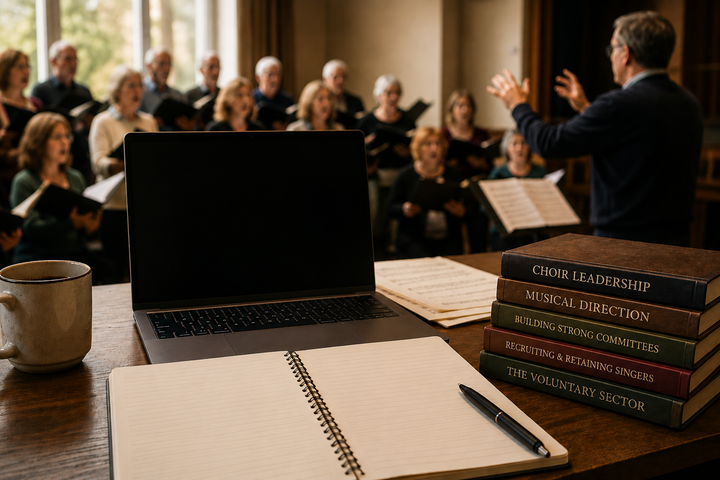
At its best, the Chairperson's role is remarkably similar to conducting.
Neither position is primarily about control. Both are about coordination, communication and helping a group of people achieve something they could not achieve individually. The difference, of course, is that one stands in front of the choir while the other sits around the committee table.
The strongest Chairpersons understand that leadership is not about being the loudest voice in the room.
It is about helping the right voices be heard.
Three Questions Every Chairperson Should Ask
Am I helping the committee reach decisions, or simply prolonging discussions?
Does the Musical Director feel supported, trusted and respected?
Are we focusing enough attention on the future of the choir, rather than simply managing the present?