Choir Rehearsal Techniques That Actually Work
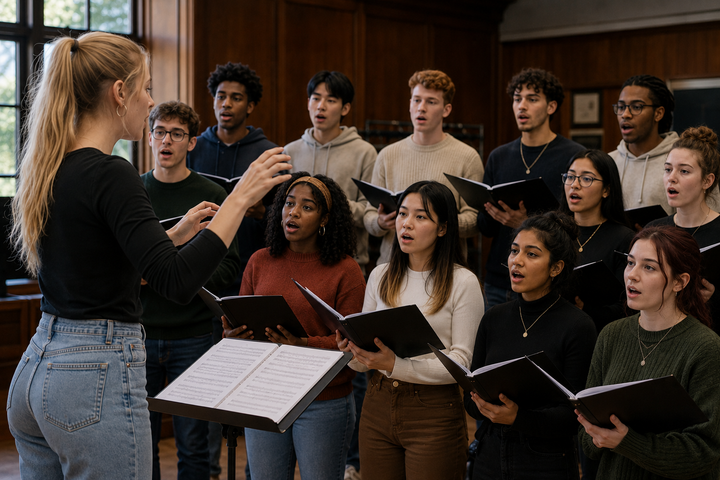
Conductors are often highly knowledgeable musicians and teachers. They naturally want to explain, describe and analyse. However, singers generally learn most effectively by singing rather than listening to lengthy lectures.

Practical Approaches for Building Better Choirs
Every conductor has experienced the temptation.
A difficult passage refuses to improve. Intonation remains stubbornly inconsistent. Rhythms continue to drift despite repeated explanations. Faced with these challenges, it is easy to assume that more rehearsal time is the answer.
Often it is not.
The reality is that the effectiveness of a rehearsal is determined less by its length and more by how that time is used. Some conductors achieve remarkable results in ninety minutes. Others can spend three hours addressing the same issue without meaningful progress. The difference usually lies not in musical ability, but in rehearsal technique.
One of the most effective techniques is also one of the simplest: stop talking so much.
Conductors are often highly knowledgeable musicians and teachers. They naturally want to explain, describe and analyse. However, singers generally learn most effectively by singing rather than listening to lengthy lectures. A concise instruction followed by immediate application will usually achieve more than a detailed explanation that lasts several minutes. The longer people stand without singing, the more energy begins to drain from the room.
This does not mean explanations have no value. Rather, it means they should be targeted and purposeful. The best conductors often say less because they have learned how to identify the most important issue and communicate it clearly.
Another highly effective technique involves isolating problems before attempting to solve them.
When something sounds wrong, conductors often rehearse entire sections repeatedly in the hope that the issue will eventually disappear. In practice, this can become frustrating for everyone involved. It is usually more productive to identify the specific source of the problem. Is it rhythm? Pitch? Text? Vowel formation? Breathing? Balance? Once the real issue has been identified, solutions become far easier to implement.
Many successful conductors also understand the value of slowing things down.
Choirs frequently struggle because they are attempting to perform music before they fully understand it. Reducing the tempo allows singers to process information more accurately and hear relationships within the music that may be obscured at performance speed. Counterintuitively, the fastest route to success is often to spend time moving more slowly.
Listening is another skill that deserves far greater attention in rehearsal.
Many singers believe their primary responsibility is to produce sound. In reality, choral singing depends equally upon receiving sound. Choirs improve dramatically when singers learn to listen actively to neighbouring voices, matching vowels, tuning intervals and balancing dynamics. Some of the most effective rehearsals are those in which conductors focus less on singing and more on listening.
Variety also matters.
Long periods spent addressing the same musical challenge can lead to diminishing returns. Attention begins to drift and concentration declines. Effective rehearsals often move between different types of activity, alternating between technical work, note learning, interpretation and complete run-throughs. This creates momentum and helps maintain engagement throughout the session.
One technique that is frequently overlooked is the strategic use of repetition.
Many conductors become concerned about repeating passages too often for fear of boring singers. Yet repetition remains one of the most powerful learning tools available. The key is ensuring that each repetition has a purpose. Singing the same phrase five times while focusing on five different aspects of performance is far more productive than singing it five times in exactly the same way.
The strongest rehearsals also create opportunities for success.
Some conductors unintentionally spend most of their time highlighting mistakes. While correction is important, singers need evidence that progress is being made. Celebrating improvements, however small, helps maintain motivation and encourages confidence. A choir that believes it is improving will often improve more quickly.
Perhaps the most important rehearsal technique of all is preparation.
The most successful conductors rarely appear to be searching for solutions in real time. They arrive knowing what they want to achieve, which passages require attention and how they intend to address likely challenges. This preparation creates efficiency and allows rehearsals to move with purpose.
There is no single rehearsal technique that transforms every choir.
Every ensemble is different. Every conductor develops their own style. Every rehearsal presents unique challenges.
However, the conductors who consistently achieve strong results tend to share certain habits. They keep instructions clear. They identify problems accurately. They encourage active listening. They use repetition intelligently. They maintain variety and momentum. Above all, they remember that rehearsals are not performances.
They are learning environments.
The choirs that improve most rapidly are usually those led by conductors who understand the difference.